By Kye Kennedy
It would only make sense for Great Britain’s racing phenomenon of the 1920s to make its way over the Bay of Biscay to the heart of Spain.
Distinct from other European neighbours, Spain had long been home to a proud population of native sighthounds known as Galgos.
These dogs quickly captured the imagination of spectators, filling some of Spain’s oldest stadiums for more than 60 years as the sport grew to become a fixture in the lives of ordinary Spaniards.
That was until 2005, when those stadiums closed their doors for the final time.
Yet the legacy of Galgo racing in Spain persists today.
The First Galgo Races
Due to the commonness of the Galgo in Spain, amateur racing and coursing-style competitions had been held in Spain since 1910 in Jerez de la Frontera.
It was only due to the success of the sport in Great Britain that Galgo societies in Spain decided to standardise racing competitions in the late 1920s.
These societies were made up of local owners and enthusiasts who worked with the owner of Madrid’s 50,000 seater Metropolitano Stadium in order to organise the first official Galgo oval track racing event in 1931.
At this event the first, set to be annual, the Spanish Greyhound Track Championship (Campeonato de España de Galgos en Pista) was held as the main attraction of the day.
In this race, owners from both Spain and Great Britain put forward their Greyhounds and Galgos in an attempt to become the country’s first major champion owner.
This honour would ultimately fall to the Brit George Gray, who won with his British Greyhound, Handy Ben.
Unfortunately, George Grey could not hope to repeat his success the following year, as a new law introduced by the Spanish government banned sports betting, effectively halting Galgo racing and all other types of racing across the country.
The ban was lifted in 1934, but the sport soon faced another setback: the outbreak of the Spanish Civil War, which disrupted competitions and stalled the return of organised racing.
The Golden Age of the Galgo
The Track Championship resumed in 1940 following the conclusion of the Spanish Civil War, though the format of the race had been changed slightly from what it was in the first edition.
Instead of individual owners submitting their Galgos for the competition, the entrants would be organised into teams based on which stadium the Galgo frequently raced at.
In the case of the 1940 Championship, the teams represented the Balearic Islands, Campo de España, Sol de Baix Park, Seville and Tenerife, respectively.
This led to the formation of the first official governing body for the sport in Spain, RFEG (Real Federación Española de Galgos).
RFEG have since governed the sport, as well as hare-coursing, in Spain for over 80 years.
The 1940 Championship was held at the Sol de Baix Park Dog Track in Barcelona, which initially opened in 1932 under the Catalan Equestrian and Greyhound Sports Association just before the ban on betting.
This was the second complex opened in Spain that was dedicated to Galgo racing, behind the Canódromo Balear in the Balearic Islands a month earlier.
As the years went by, more tracks dedicated to Galgo racing opened up across Spain, particularly in Barcelona which had become the foremost hotspot for the sport in the country.
Team format
This coincided with the success of the Track Championship, which produced a winner every year for the next 53 years under the team format.
Even so, attendances at the Track Championship and other races throughout the year were in decline by the 1980s.
This was likely worsened by the fact that, unlike Britain and Ireland, Spain lacked a robust betting infrastructure to fund prize money and track maintenance, and this left owners with little financial incentive to continue.
As a result, the Canódromo de Carabanchel in Madrid and Canódromo Loreto in Barcelona were closed and the land was redeveloped for commercial and residential purposes.
The Meridian Era
Galgo racing soldiered on across Barcelona, Palma and Valencia into the 1990s.
The decade saw the beginning of a dominant period for the Meridiana team, who by this point in history were the leading Galgo racing team in the country and the only team that spectators could be sure were not going away any time soon.
The Meridiana team won all but one of the Track Championships held in the 1990s, though the tournament was cancelled for three years running from 1994-1996 due to a financial dispute between RFEG and all of the Galgo stadiums.
By 1999, the Meridiana team was the only entrant in the annual Track Championship.
In practice, this meant the competition resembled the 1932 edition of the tournament when Galgos competed under individual ownership rather than as part of track-affiliated teams.
The official format, however, remained unchanged, and Meridiana continued to be recognised as the winning team each year.
Fragile state
For some observers, this situation highlighted the increasingly fragile state of the sport during what would be its final years.
The Spanish Greyhound Track Championship was held for the final time in 2005, bringing a close to more than sixty decades of organised Galgo track racing in Spain.
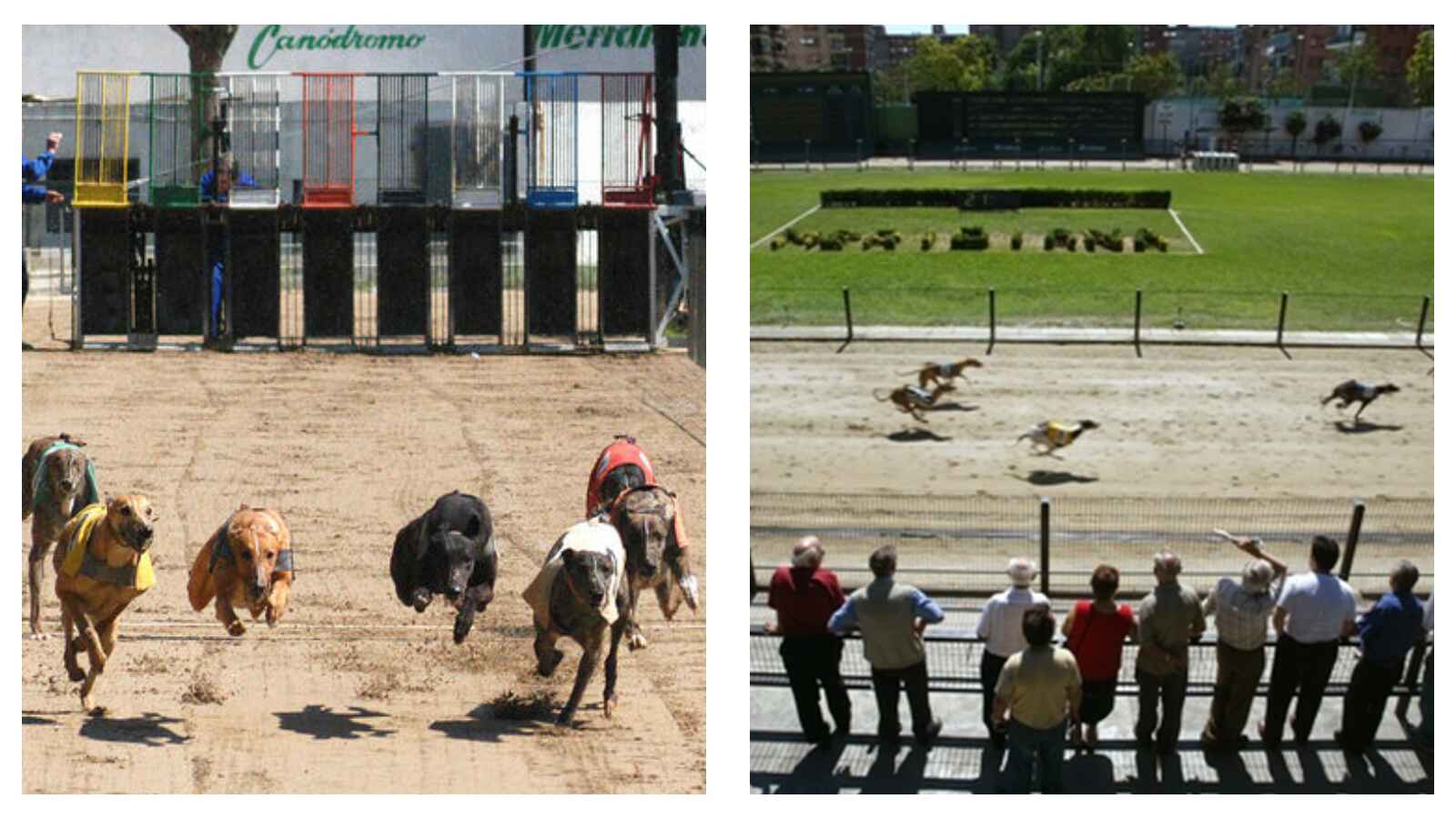
By this stage the Track Championship had become entirely dependent on Barcelona’s Canódromo Meridiana, the last operational oval track in the country.
Without other venues to sustain a national circuit, the competition could no longer continue.
The situation became definitive the following year when the Meridiana track itself closed in 2006 after racing was deemed financially unsustainable.
Modern Galgo Racing
Since the conclusion of Spain’s major Greyhound track racing championship in 2005, the sport has all but disappeared from the national spotlight.
The country’s last operational oval track, Barcelona’s Canòdrom Meridiana, closed in 2006 after being deemed unprofitable, and the site was redeveloped as a cultural arts centre.
With no stadiums left to host the sport’s flagship events, enthusiasts turned to the annual mechanical-lure championship, the Campeonato de España de Galgos sobre Liebre Mecánica.
Established in 1988, this competition is traditionally held on a straight track in a rural field rather than a traditional oval stadium.
Although both tournaments fall under the governance of RFEG, the mechanical-lure championship has historically been considered a secondary event, largely because of the enduring popularity of hare coursing in Spain.
Fully sanctioned
Unlike in Great Britain, hare coursing remains fully sanctioned in Spain and continues to draw hundreds of spectators to the RFEG’s major events each year.
Organising these modern mechanical-lure events has not been without its challenges.
Reports from the late 2000s suggested that staging a single championship meeting could cost around $15,000, with approximately $6,000 allocated to prize money, requiring organisers to rely heavily on local support and federation resources to keep the competition viable.
Despite these financial pressures, the sport has settled into a modest but sustainable rhythm in the years since the closure of the stadium tracks.
Without the scale or commercial expectations of the old oval circuits, mechanical-lure racing now survives largely through the dedication of breeders, owners, and regional clubs.
In that sense, while Galgo racing in Spain no longer commands the crowds it once did, it endures in a quieter form, sustained by those determined to preserve the tradition.
READ NEXT: First Dunstall Park dual fixture a “huge success”