Could the wind be the most overlooked influence on a greyhound race?
“I’ve studied form for thirty-odd years, and I’ll tell you this – some nights there’s seven runners, not six. One of ’em just doesn’t show up on the racecard.” — Richie, long-time Romford track regular Every greyhound punter knows the feeling.
You have spent half the afternoon studying the form. You’ve checked the sectional times, compared recent finishes, scrutinised the trap draws and examined the trainer statistics. You’ve even convinced yourself that the outsider in trap five has absolutely no chance whatsoever.
Your selection looks a certainty. Then the traps fly open, your carefully chosen runner rockets into the lead, and somewhere down the back straight it suddenly looks as though somebody has pulled the emergency brake.
Meanwhile, a dog you barely gave a second glance to begins picking off its rivals, eventually steaming past your selection as though it has somewhere much more important to be.
What went wrong? Was your reading of the form hopelessly wide of the mark? Did your fancy simply run out of puff? Or could there have been another, rather less obvious factor at work?
Something you won’t find listed alongside the dog’s recent form, calculated into its speed rating or mentioned in the pre-race analysis?
Ladies and gentlemen, allow me to introduce the unsung seventh runner. The wind.
An invisible opponent
Greyhound racing has always been a sport of fine margins. A fraction of a second at the traps, a tight turn into the first bend or a moment’s hesitation can transform a promising run into a frustrating defeat.
Punters spend hours trying to identify those margins. We analyse early pace, calculate winning times, compare grades and look for patterns that might give us an advantage over the market.
Yet how often do we stop to consider the conditions in which the race is actually being run?
At an exposed track, the weather could be worth paying attention to. A breeze blowing down a straight might affect runners differently depending on its direction, strength and how much of the race is spent running into it.
Of course, wind isn’t some mysterious force that automatically turns front-runners into losers and backmarkers into champions. Greyhounds are powerful athletes, and a light breeze might make absolutely no measurable difference to the outcome.
But that raises an interesting question: are we sometimes so busy studying the dogs that we forget to look at the environment in which they are racing?
Think about that the next time you are standing trackside at Romford, clutching a racecard in one hand and a rapidly cooling cup of coffee in the other.
When the wind is in their faces
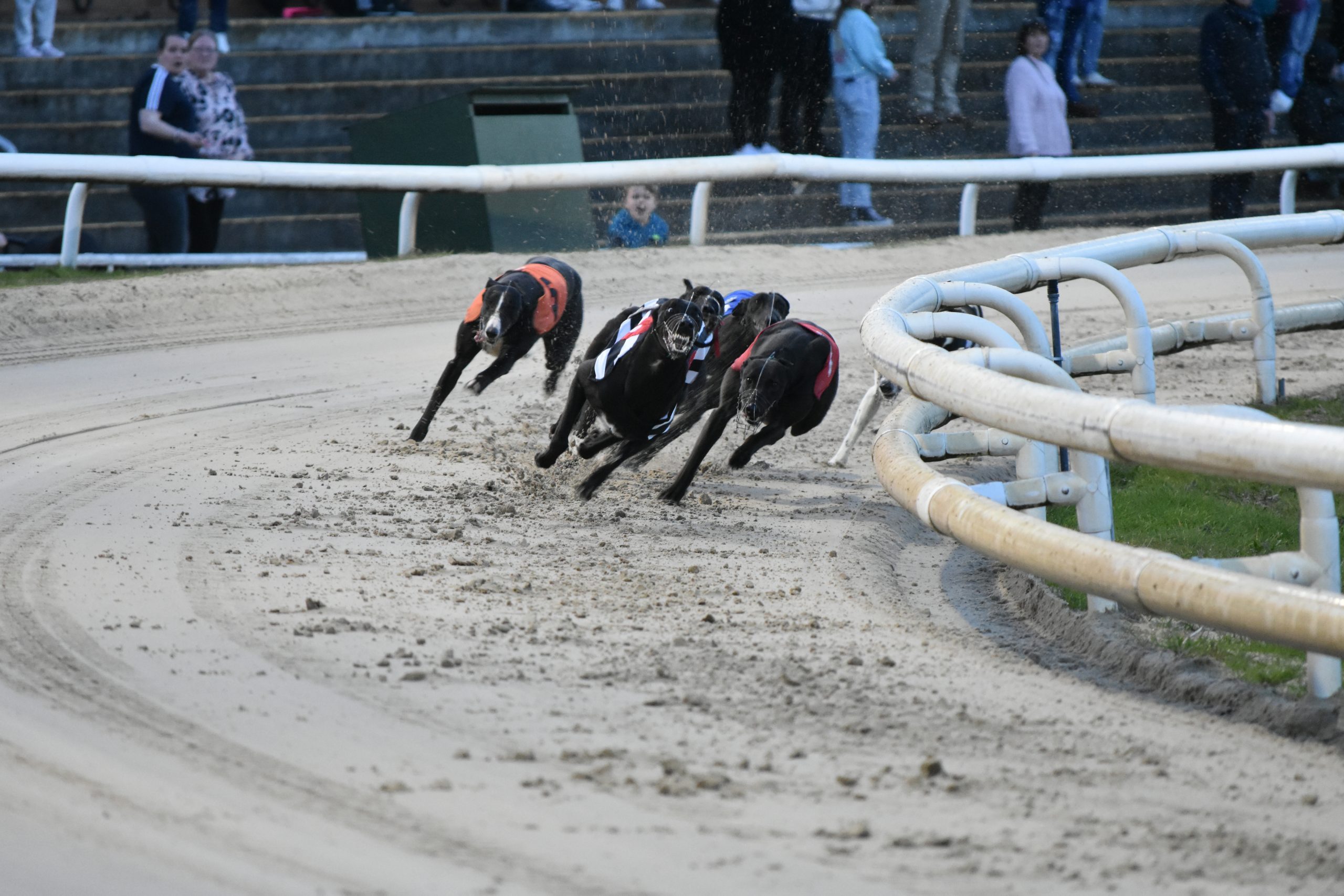
Imagine a typical evening meeting. The floodlights are blazing, the crowd is buzzing, the smell of chips hangs in the air and a steady breeze is making its presence felt along the home straight. On paper, the opening race looks straightforward enough.
Trap one has a reliable railer. Trap two possesses respectable early pace. Trap three has been finishing strongly, while trap four is coming into the race after a couple of encouraging performances.
The figures tell one story. But what about the conditions?
If the wind is blowing directly into a runner’s face along a particular section of the track, it creates additional aerodynamic resistance. The actual effect on an individual greyhound will depend on the conditions and the dog’s speed, position and running style.
At racing speeds, air resistance can become significant. However, without reliable measurements, it’s impossible to say whether a particular breeze has cost a dog a fraction of a second or made no meaningful difference at all.
Nevertheless, it’s an intriguing consideration. Could a dog that relies heavily on blasting into an early lead be more affected by a headwind than we might expect? Might a strong finisher benefit if the pace-setters expend a little more energy than usual? Possibly. But there is a catch.
A dog coming from behind doesn’t automatically receive a useful aerodynamic advantage simply because it follows another runner. The distance between the dogs, their positioning and the direction of the wind all matter. And in a tightly contested race, crowding and interference can easily outweigh any theoretical benefit.
Still, the idea gives us another way to think about how a race might develop.
Rather than asking only: “Which dog is quickest?” we can also ask: “Which dog is best suited to the conditions tonight?”
It is a subtle distinction, but an interesting one.
Not all breezes are created equal
Here is where things get particularly interesting. A wind blowing into a dog’s face on the back straight could have a very different effect from one blowing across the track or behind the runners on the home straight.
And remember, the dogs don’t run in a straight line for the entire race. They’re negotiating bends, changing positions and accelerating out of corners.
Wind direction relative to the direction of travel is therefore crucial. A headwind may increase resistance. A tailwind may reduce it. A crosswind could affect runners differently depending on its strength and the circumstances.
But don’t expect the weather forecast on your phone to hand you the winner on a plate.
A forecast describing a moderate westerly wind does not tell you precisely what conditions the dogs will encounter at every point around a particular circuit. Local buildings, grandstands, track layout and other obstacles can alter airflow. To understand the potential effect properly, you would need to know the actual wind conditions around the track, not simply whether it is breezy outside the pub.
And even then, you’d need evidence that those conditions consistently influence finishing times or winning probabilities. That is the difference between an interesting theory and a genuinely useful betting angle.
The art of watching, not just reading
One of the great pleasures of greyhound racing is that the formbook never tells you absolutely everything.
You can study a dog’s record and know its recent times, grades and finishing positions. But watching it race can reveal details that a list of figures does not always capture. The same applies to changing conditions.
A regular trackgoer might notice that the flags have been flapping steadily throughout the evening, that the wind has changed direction or that the conditions have become noticeably calmer.
These observations are worth recording if you are interested in whether weather has any measurable relationship with performance.
What isn’t worth doing is immediately deciding that a particular dog dislikes the wind because it finished fifth on a breezy Tuesday. That is a conclusion looking for evidence.
The dog might have missed the break, encountered trouble at the first bend, been carrying an injury or simply faced stronger opposition.
Equally, a winner on a windy night hasn’t necessarily benefitted from the conditions.
This is where the experienced racegoer needs to separate observation from imagination.
There is nothing wrong with having a theory. The trick is being willing to discover that you are wrong.
Can the wind actually help your betting?
Let’s be realistic. If you’re betting at Romford, early pace, trap position, recent performance, grade and the likelihood of trouble should remain central to your assessment.
A dog with superior early speed and a favourable draw doesn’t suddenly become a poor selection because the wind has picked up.
Likewise, a slow starter with inconsistent form doesn’t become a value bet simply because you suspect the conditions might favour a finisher.
The danger is that punters love finding explanations for unexpected results.
When our selection wins, we congratulate ourselves on spotting the form. When it loses, we are quick to blame the trap draw, the bend, the hare, the interference or practically anything else that comes to mind.
The weather makes another convenient suspect.
Psychologists call one common version of this problem confirmation bias: we remember the occasions that support our theory and overlook the occasions that contradict it.
If you genuinely want to investigate the wind as a betting factor, there is a simple way to start. Keep a record. Note the wind direction and approximate strength before each meeting. Record the track, distance, race grade, trap draw, sectional times and finishing times. Pay particular attention to whether the wind is a headwind or tailwind along the straights.
Then compare races run under different conditions.
Don’t just record the winners. Include the losers, too.
Look for repeated patterns across a meaningful number of races rather than drawing conclusions from one or two memorable results. Where possible, compare similar grades and distances, and account for differences in the quality of the runners.
Most importantly, don’t confuse a pattern with proof of a profitable betting system.
Even if the weather appears to influence performance, that doesn’t automatically mean the market has overlooked it. To establish a betting advantage, you’d also need to show that your predictions are accurate enough to overcome the odds and betting costs over time. That is a much tougher test. But it is also a far more interesting exercise than simply blaming the wind every time your selection gets beaten!
The seventh runner: friend or foe?
Perhaps the most appealing thing about this theory is its simplicity.
Greyhound racing takes place in the real world, where conditions are not always identical from one meeting to the next. Yet punters can become so absorbed in historical statistics that they forget the race unfolding in front of them is happening here and now.
A dog’s previous winning time was recorded under particular circumstances. Tonight’s race will take place under whatever conditions prevail at the track.
That doesn’t make historical form irrelevant. Far from it.
It simply reminds us that racing is a combination of known information, changing circumstances and uncertainty.
And perhaps that is why the wind makes such a good talking point.
It cannot be assigned a trap number. It doesn’t have a trainer, a kennel name or a string of impressive recent performances. You won’t find it quoted at 5-1 by the bookmakers.
Yet, under the right circumstances, it could be one more environmental variable worth investigating. The important word is ‘could’. Without proper data, we cannot confidently say how much difference it makes, which running styles benefit most or whether any effect is large enough to influence a betting decision.
But asking the question is a perfectly reasonable starting point.
Look up before you look down
So, next time you’re at Romford, take a moment before the first race.
By all means, study the racecard. Compare the sectionals, assess the early pace and look for runners whose recent performances suggest they are ready to strike.
Then look up. Check the flags. Notice the conditions. Ask yourself whether the wind is blowing along the straights, across the track or changing throughout the evening.
Treat it as an observation rather than a prediction, and see whether your notes reveal anything worth investigating.
Don’t throw away a good selection because there is a breeze, and certainly don’t back an outsider simply because you fancy the weather might be on its side.
Bet within your limits, remember that every race carries uncertainty and never stake money you cannot afford to lose. But do keep your eyes open. Because the next time your carefully chosen front-runner fades and an unfancied rival sweeps past, you might find yourself wondering whether the explanation was hiding in plain sight.
Or perhaps your selection simply wasn’t good enough.
That’s the beauty of greyhound racing: sometimes the answer is in the form-book, sometimes it is in the race itself, and occasionally the debate continues long after the last dog has crossed the line.
And if somebody beside you starts insisting that the wind cost them a winner, there is no need to argue.
Just smile, glance at the flags and ask them one question: “Interesting theory. Have you got the figures to prove it?”
Because in greyhound racing, as in betting, a good story is entertaining.
But a winning angle needs evidence.
RA
Francis Fitzgerald is presenter of Mark Your Card on Instagram, TikTok and YouTube